What people are calling the “death of SaaS” is; in many ways, a misunderstanding of how enterprise technology actually evolves. Every major technology wave arrives with a prediction that the previous generation will disappear. It never does. Mainframes survived client-server. Client-server survived the cloud. On-prem survived SaaS.
And SaaS will survive AI.
The reason is simple: enterprise architectures are not static software stacks. They are living systems built over decades, layered with business logic, operational processes, integrations, compliance controls and human workflows. You cannot simply “replace” them because a new technology paradigm appears.
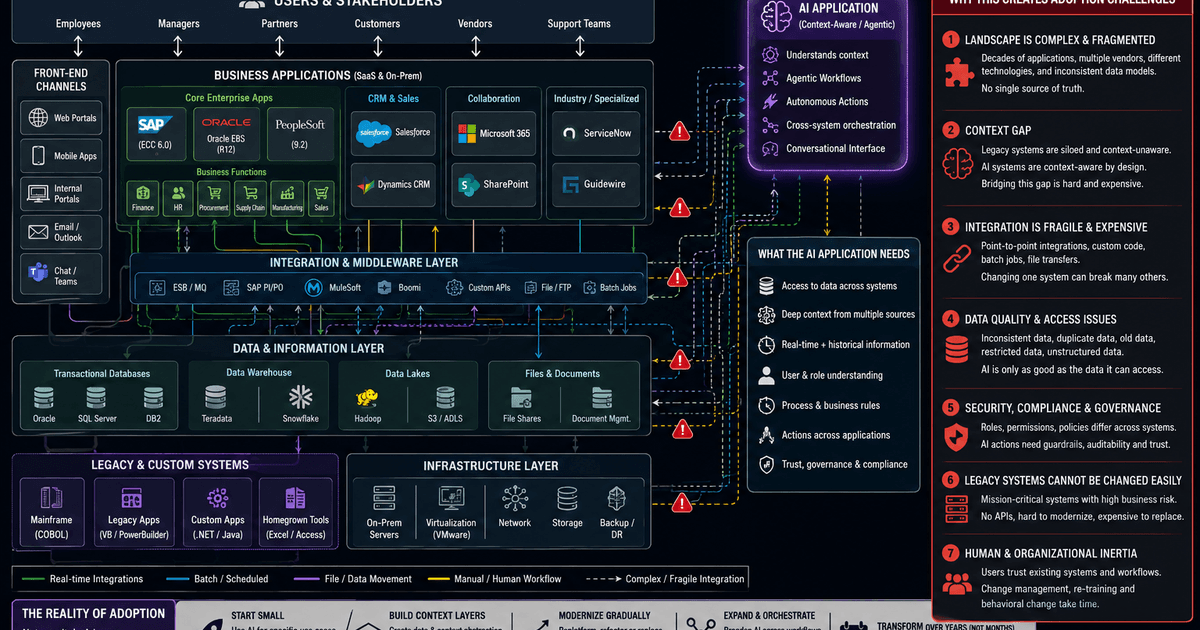
Take SAP as an example. There are versions of SAP that were deprecated more than a decade ago and still continue to run the operational core of some of the world’s largest enterprises. Not because companies are unaware of newer technologies, but because these systems are deeply intertwined with finance, procurement, supply chain, manufacturing and compliance processes. Replacing them is not a software migration exercise. It is organizational surgery. Now extrapolate that reality across hundreds of enterprise applications:
- ERP systems
- CRM platforms
- Identity systems
- Procurement platforms
- Industry-specific operational software
- Custom middleware
- Legacy databases
- Reporting layers
- Workflow engines
What emerges is not a clean architecture diagram, but a complex, living ecosystem of interconnected systems accumulated over years of operational evolution. Into this environment, the industry now wants to introduce AI-native and agentic architectures. That is where the real challenge begins. One of the defining characteristics of earlier enterprise software generations was that they were largely siloed and context-unaware. Most traditional systems were designed around transactional workflows:
- Input
- Process
- Output
They were not built to understand broader organizational context. AI systems, on the other hand, are fundamentally different. By design, they are context-aware. Agentic systems especially depend on context:
- organizational context
- workflow context
- historical context
- behavioral context
- permission context
- relationship context
An AI agent cannot operate effectively in isolation. It needs awareness across systems, workflows and data domains. But when a context-aware AI architecture tries to interact with fragmented, siloed, context-unaware enterprise systems, friction becomes inevitable. The AI layer then has two difficult choices:
- Build massive abstraction and orchestration layers on top of legacy systems
- Rewrite applications to become AI-native
Both paths are expensive, slow and organizationally disruptive. This is why the idea that AI will instantly replace SaaS misunderstands enterprise adoption cycles. AI will absolutely reshape enterprise software. The magnitude of disruption may even exceed the cloud transition. But disruption and adoption are not the same thing. Adoption in enterprises is never a switch you simply turn on.
Historically, infrastructure transitions require applications to be rewritten in order to fully exploit the new architectural paradigm underneath them. Cloud computing is the perfect example.
When cloud arrived, enterprises initially lifted and shifted existing applications. But the real value of cloud only emerged when applications were rebuilt as cloud-native systems:
- microservices
- distributed architectures
- elastic scaling
- API-first design
- containerization
Similarly, AI-native infrastructure will require AI-native applications.Existing SaaS products were largely built for deterministic workflows and human-operated interfaces. AI-native systems will increasingly be designed around:
- autonomous workflows
- probabilistic reasoning
- contextual memory
- orchestration across systems
- conversational interfaces
- agent collaboration
That transition will not happen overnight. In many cases, it may take decades. What will move faster are new applications being built today. Startups and greenfield systems have the advantage of designing directly for the AI stack rather than retrofitting old architectures. But large enterprises operate under a very different reality:
- operational continuity matters
- compliance matters
- reliability matters
- integration stability matters
- human process alignment matters
And finally, there is the most underestimated factor in all technology transitions: human behavior. Technology adoption is not purely technical. It is organizational and psychological.
- Enterprises have institutional inertia.
- People have workflow inertia.
- Teams have process inertia.
Human systems resist abrupt change even when the technological benefits are obvious. Which means the future is unlikely to be “AI replaces SaaS.”
The more realistic future is:
- SaaS evolves
- AI layers emerge on top
- Most applications get rewritten
- new AI-native systems coexist with legacy systems
- enterprises gradually transition over long adoption cycles
The next decade will likely look less like extinction and more like coexistence orchestration and gradual architectural convergence. AI is not destroying enterprise software.
AI is forcing enterprise software to evolve, slowly, painfully and unevenly, exactly the way every major enterprise technology transition has happened before; albeit at a much faster pace.