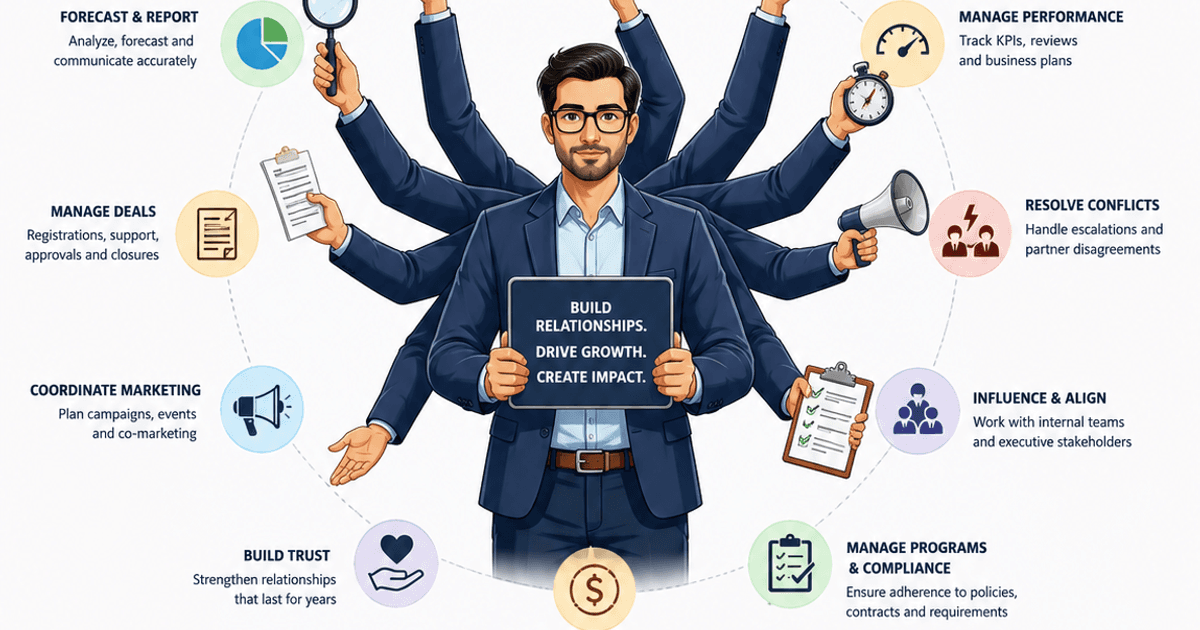
For decades organizations have depended on channel managers to build, nurture and scale partner ecosystems. Yet very few roles in the technology industry are as misunderstood, under-defined and more overloaded with expectations. A channel manager is expected to:
- Recruit partners
- Build trust
- Enable sales teams
- Drive pipeline
- Resolve conflicts
- Coordinate with marketing
- Manage partner skills & certifications
- Influence senior executives
- Forecast revenue
- Ensure partner satisfaction
- Handle escalations
- Track compliance
- Drive renewals
- Expand territories
And often, they are expected to do all of this simultaneously across dozens; sometimes hundreds of partners spread across geographies, industries and business models.
The irony? Most organizations still define the role with a generic title and a broad job description. In reality, channel managers are among the most strategically complex roles in modern B2B organizations.
Why so many channel roles fail
Organizations fundamentally misunderstand the nature of ecosystem management. Most companies unconsciously model channel roles using direct sales logic. That is the first mistake. A salesperson typically operates within a structured environment:
- Defined territory
- Defined product
- Defined quota
- Defined customer segment
- Clear reporting hierarchy
- Direct organizational control
Success is largely measured through transactional outcomes:
- Pipeline
- Revenue
- Closures
- Forecast accuracy
A channel manager operates in a completely different environment. They do not manage employees. They manage independent businesses and those businesses:
- Have their own priorities
- Represent multiple vendors
- Operate in different territories
- Focus on different industries
- Sell differently
- Deliver differently
- Optimize for their own profitability
This means the channel manager operates in a system without direct authority. Instead of control, they rely on:
- Influence
- Trust
- Alignment
- Relationships
Yet organizations often evaluate them using short-term sales metrics designed for direct sales teams. That mismatch creates structural failure.
The core problem: Partners are not homogeneous
Unlike direct employees, partners are independent entities with unique business identities. Every partner has its own:
- Revenue goals
- Customer base
- Territory focus
- Vertical specialization
- Technical capability
- Sales culture
- Incentive model
- Strategic priorities
A cybersecurity-focused MSP in Singapore behaves very differently from a cloud reseller in India or an AI-native consultancy in the United States. Yet many organizations expect one channel manager to effectively handle all of them under a single role definition. That is where the disconnect begins.
Ecosystem management is relationship management at scale
Direct sales organizations operate with internal alignment:
- Shared KPIs
- Shared reporting structures
- Shared compensation plans
- Shared organizational goals
Partner ecosystems operate differently. Partners:
- Shift priorities based on market conditions
- Balance multiple vendor relationships
- Need business justification for every investment
- Require continuous engagement and enablement
This means a channel manager cannot simply “manage accounts.” They must continuously:
- Interpret partner intent
- Understand partner economics
- Align incentives
- Build long-term trust
- Navigate conflicts
- Coordinate multiple stakeholders
- Identify strategic fit
In many ways, the role resembles that of a network orchestrator more than a traditional sales manager.
The long gestation period of ecosystems
Another reason channel roles fail is because organizations underestimate the time ecosystems take to mature. Strong partner ecosystems are not built in quarters. They are built over years. A meaningful partner relationship often takes:
- 6–9 months to establish trust
- 9–12 months to operationalize jointly
- 12–18 months to become strategically productive
Yet many organizations:
- Change partner ownership frequently
- Rotate territories rapidly
- Shift priorities every few quarters
- Expect immediate pipeline contribution
The result:
- Partner fatigue
- Broken continuity
- Weak ecosystem loyalty
- Reduced engagement
- Poor activation rates
Partnerships compound over time. Trust cannot be accelerated through process alone.
The Modern channel manager is an ecosystem intelligence role
Today’s ecosystems are more complex than ever before. Partners are no longer just resellers. They may simultaneously act as:
- Advisors
- System Integrators
- MSPs
- Cloud migrators
- Consultants
- Design partners
- Marketplace sellers
- Implementation specialists
- AI transformation providers
This complexity requires a new kind of channel professional:
- Someone who understands relationships
- Someone who understands ecosystem dynamics
- Someone who can connect signals across multiple stakeholders
- Someone who can identify strategic alignment beyond transactional revenue
The modern channel manager is becoming:
- A relationship architect
- A trust builder
- An ecosystem strategist
- A distributed growth orchestrator
Why technology alone cannot solve the problem
Many organizations assume PRM systems alone can solve ecosystem complexity. But ecosystems are not merely workflow problems. They are relationship systems.
Technology can help automate:
- Discovery
- Onboarding
- Scoring
- Certifications
- Deal registration
- Communication
- Intelligence gathering
But technology cannot fully replace:
- Trust
- Strategic alignment
- Human influence
- Contextual understanding
- Executive relationships
hence the future is not about replacing channel managers with AI. It is about augmenting them. AI and ecosystem intelligence platforms should remove operational friction so channel professionals can focus on what truly matters:
- Relationship building
- Ecosystem strategy
- Partner growth
- Long-term value creation
The real organizational challenge
The biggest issue may not be channel execution itself. It may be the lack of precision in how organizations define the role. When channel managers are expected to manage:
- Different partner types
- Multiple territories
- Diverse industries
- Complex customer segments
without clear ownership boundaries or specialized support organizations create structural inefficiency. The more heterogeneous the ecosystem becomes, the more precisely the role must be defined.
Final Thoughts
Channel managers are often called “jack of all trades.” But the reality is more demanding than that. Organizations expect them to be:
- Strategists
- Operators
- Relationship managers
- Negotiators
- Analysts
- Enablement leaders
- Revenue drivers
- Ecosystem builders
In other words, they are expected to be masters of all too. As the AI era accelerates product creation and lowers barriers to innovation, distribution and ecosystem orchestration will become even more important and that means one thing is becoming increasingly clear:
The future of growth belongs not just to companies with great products, but to companies with great ecosystems and the channel managers capable of orchestrating them.