
Most organizations don’t lack systems.
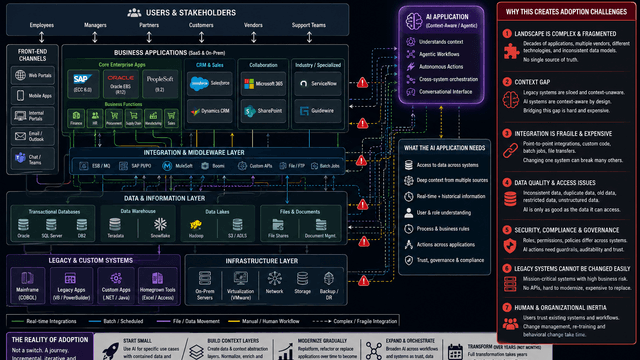
Over the years, they’ve invested in CRMs, ERPs, finance tools, partner platforms, internal dashboards, and a long list of niche software that only one team truly understands. Each of these systems works reasonably well on its own. The trouble begins when we ask AI to work across them.
On paper, this sounds simple. “Just connect the AI to our APIs.” In practice, this is where things quietly fall apart.
The problem isn’t access to data. It’s access to context. Not just what the data is, but why it exists, how it’s allowed to change, and where it sits in a real business workflow.
This is where the Model Context Protocol (MCP) takes a different path. Instead of treating integration as a data plumbing problem, it treats it as an architectural problem. One that needs to respect business logic, security boundaries, and the messy reality of how work actually gets done.
Why Traditional Integration Struggles with AI
To understand why MCP exists, it helps to look at where traditional integrations start to show their limits. These aren’t just technical gaps.
APIs Solve Access, Not Understanding
APIs are good at what they were designed for: exposing data and functions in a structured way. What they don’t do is explain meaning.
An API can tell an AI:
- Here is a customer record
- Here are the fields you can update
- Here’s the endpoint to call
What it can’t easily tell the AI:
- Why some fields are locked right now
- Whether this customer is midway through an approval flow
- How this record relates to partners, invoices, or contracts in other systems
- What shouldn’t be done, even if it’s technically possible
This gap becomes obvious the moment AI is expected to act, not just read.
Imagine an AI assistant helping someone onboard a new partner. Creating the record is easy. But real onboarding involves:
- Placing the partner under the right parent entity
- Verifying required documents before activation
- Syncing the change across CRM, billing, and delivery systems
None of this lives cleanly inside a single API call.
Security Isn’t a Wrapper You Add Later
Enterprise systems carry years of hard-earned security logic:
- Role-based access
- Org-level data segregation
- Approval chains
- Audit trails
- Compliance constraints that exist for good reasons
Traditional AI integrations often flatten this into “does the token have access or not?” That’s not enough.
AI introduces new questions:
- How do you audit actions initiated by an AI?
- How do you prevent it from leaking sensitive data through inference?
- How do you ensure it respects business state, not just user identity?
Security, in this context, isn’t a checkbox. It’s part of the architecture.
Workflows Don’t Live in One Place
Real business workflows cut across systems.
A lead might start in a marketing tool, move to a CRM, trigger partner involvement, require finance approval, and eventually land in a delivery or project system. Humans carry this context in their heads. Systems don’t.
Traditional integrations connect data points, not processes. AI, however, needs to understand the shape of the workflow to be genuinely useful.
Without that, it can answer questions, but it can’t guide, anticipate, or warn.
MCP’s Core Philosophy
Separating Data, Logic, and Presentation
MCP enforces a clean separation between three things that often get tangled together:
Data:
The raw records: customers, invoices, partners, transactions. MCP exposes this data without breaking the underlying relationships or models.
Logic:
The rules that govern how that data can change: validations, permissions, workflow states, approvals. MCP makes this logic visible and understandable instead of burying it inside application code.
Presentation:
How actions and information are shown to users. MCP lets AI adapt its responses to context without inventing its own version of the business UI.
This separation matters because it allows AI to operate intelligently without bypassing safeguards.
Tools, Not Just Endpoints
In MCP, business capabilities are exposed as tools, not generic CRUD operations.
A tool represents an intent:
- Create a lead
- Approve an expense
- Update a partner agreement
This has a few important benefits:
- AI can discover what’s actually possible
- Inputs and errors are consistent
- Tools can be composed into larger workflows
- Versions can evolve without breaking everything upstream
It’s a small shift in framing, but it changes how reliably AI can operate.
From Siloed Systems to Shared Intelligence
The real payoff of MCP isn’t just cleaner integration. It’s AI that can reason with the business the way the business actually operates.
Contextual Data, Not Just Aggregated Data
When AI accesses a customer through MCP, it doesn’t just see a record. It sees:
- Related partners
- Pending approvals
- Where this customer sits in active workflows
That context is what allows AI to move from answering questions to offering useful guidance.
Workflows That Don’t Break at System Boundaries
Because MCP understands workflows across systems, AI doesn’t lose context as work moves from one tool to another. It can track what’s already happened, what’s pending, and what should happen next.
MCP assumes change is constant. New tools and capabilities can be added without breaking existing behavior. Old and new workflows can coexist while teams transition. Validation, compliance rules, and constraints can grow alongside the business instead of forcing a rewrite. The result is an integration layer that reflects how organizations actually operate: incrementally, unevenly, and under real-world pressure.
How to Approach MCP in Practice
If you’re thinking about implementing MCP, a few grounded suggestions:
MCP isn’t about chasing the latest AI feature. It’s about creating an integration foundation that holds up as systems, workflows, and interaction patterns evolve. In practice, that means focusing less on novelty and more on durability.
- Start with workflows that already hurt. Cross-system, high-friction processes show value fastest.
- Write down your business rules. MCP shines when logic is explicit instead of tribal knowledge.
- Evolve incrementally. Let AI earn trust before handing it more responsibility.
At its core, MCP reflects a fairly simple idea: AI shouldn’t be a clever outsider poking at your systems. It should be a well-behaved participant, aware of context, respectful of rules, and capable of growing with the business.
That’s what makes the architecture interesting. And, more importantly, usable.
This direction isn’t theoretical. On December 9, 2025, Anthropic donated the Model Context Protocol to an independent foundation to ensure it remains open, governed, and shaped by real-world use.
Channlworks is an alliance intelligence platform that helps companies build and operate partner ecosystems, supporting partner discovery, onboarding, enablement, and ongoing management across systems. If you’re looking to bring AI into your partner workflows without breaking how your business actually runs, Channlworks provides a practical foundation, with native support for the Model Context Protocol (MCP) as part of its broader platform capabilities.