Foreword
Startups don’t fail because they lack ambition. They fail because they run out of
time, customers and leverage. The truth is, no startup can win alone anymore.
Markets move too fast, buyers trust networks over ads and execution speed
matters more than ideas. This playbook is built on one radical premise; alliances
are the new GTM superpower.
When done right, they compound your reach, credibility and growth far beyond
what any direct sales team can deliver. When done wrong, they waste cycles,
confuse your teams and stall momentum.
Inside these pages, you’ll find hard-earned lessons, tested frameworks and real
stories of startups that turned partnerships into engines of scale. It’s not theory,
it’s the operating manual for founders and GTM leaders who want to build
through the ecosystem, not around it. If you’re a startup founder trying to
decide when to partner, how deep to invest and what “partner-ready” really
means this playbook will show you the path. Because in the new world of GTM,
alliances aren’t optional—they’re existential.
The companies that master ecosystem thinking early will own the next decade
of growth.
CEO at Partnership Leaders
Preface
In the world of startups, the journey is inherently risky. Founders are constantly navigating uncertainty; from achieving product-market fit to finding their first set of customers and deciding how to allocate limited resources. Amid these pressures, certain growth opportunities, especially those around building an indirect GTM or partner-led ecosystem, are often overlooked.
This playbook aims to fill that gap. Drawing from my own experience as a founder and my early interactions and learnings from channel leaders and startup executives during my time at AWS India, I wanted to create a practical guide that helps startups understand not just if they should build a partner ecosystem, but when and how tailored to their stage, maturity and growth trajectory.
Ecosystem Philosophy for startups
Building an ecosystem is an investment. Thinking long term helps in the maximum gains. Just like timing a market doesn't help, building transactional relationships can’t help in the long run. Invest deep, invest long to get the best out of your alliances. When the ecosystem thrives, so does the startup, the partners and the customer community that connects them all.
Setting the tone
Q. Define “indirect GTM” or “channel-led growth”?
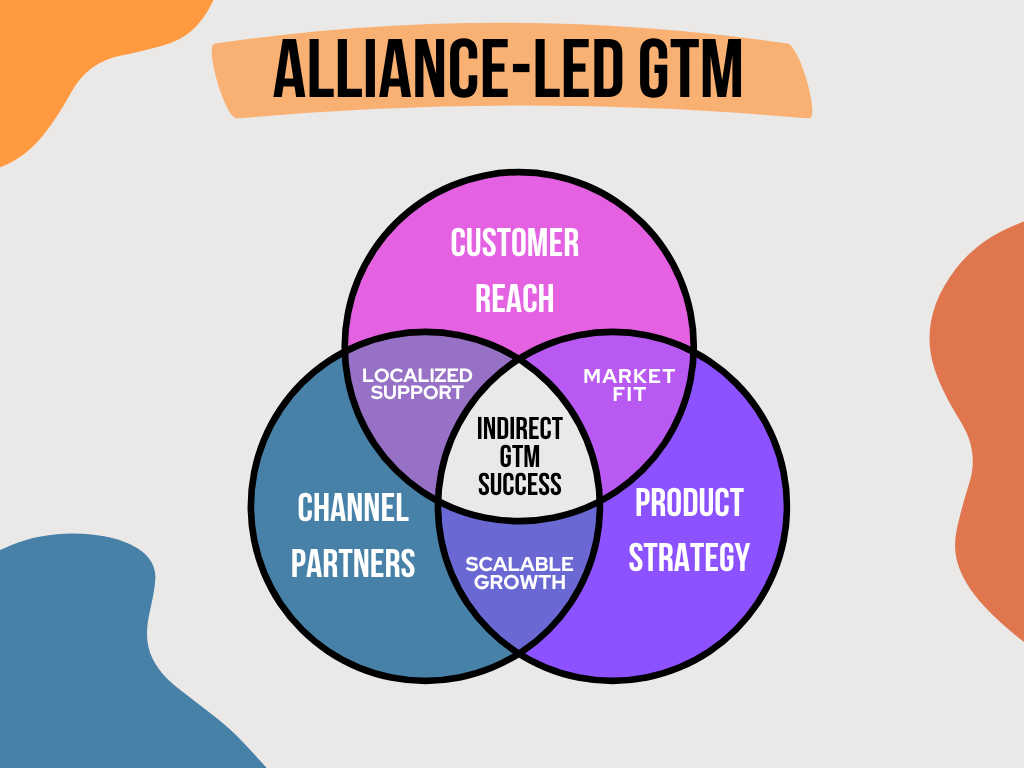
R. When we talk about indirect GTM , we’re referring to a go-to-market strategy that relies on a network of partners rather than direct sales alone. Instead of building an extensive in-house sales team or managing every customer relationship yourself, you work through intermediaries, such as resellers, distributors, system integrators, consultants or other ecosystem players, who already have established access to your target market.
At its core, indirect GTM is about amplifying reach and accelerating market entry by leveraging the trust, relationships and domain expertise of partners. These partners help take your product to customers faster, often with stronger local context and deeper vertical insight than a startup could achieve on its own. In essence, it’s a multiplier strategy, using collaboration to extend your commercial footprint and unlock growth that would otherwise take years to build organically.
Q. What misconceptions do founders usually have about building through partners?
R. One of the most common misconceptions founders have is that working with partners is a slower or more complicated way to sell. Many assume it’s faster to build a direct sales team and maintain full control, but that view often underestimates the strategic leverage partners bring beyond just sales execution.
Another frequent myth is that partners dilute the brand or create channel conflict. In reality, a well-structured partner program can enhance credibility, expand market presence and create alignment rather than competition.
Founders also often overestimate the complexity of partner management, assuming it requires a massive team or expensive systems. In truth, even a small, focused partner ecosystem can be run in a lean, agile way. The key is to view your partners not as competitors to your sales team but as an extension of it, a multiplier that accelerates growth when resources are limited and markets are wide.
Q. What outcomes should a founder expect if they adopt a partner-led GTM early?
R. A partner-led GTM, when conceptualized early, can pay long-term dividends. Founders who embed ecosystem thinking into their growth model can expect outcomes across multiple dimensions, from expanded reach into new segments, verticals and geographies, to inorganic brand amplification driven by the network effect. At its core, a partner-led motion is a distribution strategy, not just a sales tactic. When founders design their GTM with this mindset, they build a scalable distribution pipeline that compounds over time, enabling faster market entry, stronger credibility and more sustainable growth than direct efforts alone.
Defining the Ecosystem
Q: What exactly constitutes an ecosystem today- and how has that definition evolved?
R. The definition of an ecosystem has evolved dramatically over the decades. From the earliest days of technology, when the first lines of software code were written and the first pieces of hardware were shipped, some form of ecosystem has always existed. In its simplest form, it represented the interconnected network of creators, sellers and servicers that collectively delivered value to the customer.
Over time, as products, platforms and customer journeys became more complex, the boundaries of the ecosystem expanded. What was once a narrow chain of suppliers and resellers has now become a vast, dynamic web of players whose interactions continuously move the business forward.
Today, an ecosystem can be understood as a superset of all participants whose activities influence how products and services are created, distributed, adopted and supported. Within it are companies that build (ISVs, OEMs), sell (resellers, distributors, marketplaces) and serve (system integrators, MSPs, consultants, influencers), each playing a distinct role in taking a solution from origination to the end customer.
In earlier eras, the ecosystem was easier to define because touchpoints were fewer and roles were clearly demarcated. But in the modern world, a single customer might interact with as many as ten different ecosystem players across their buying journey. This expansion has made the ecosystem both more complex and more powerful, a living network that continuously shapes how markets evolve and how innovation reaches users.
Q: Who are the primary players in a typical B2B tech ecosystem- and how do they interact?
R. A typical B2B tech ecosystem is made up of multiple layers of partners, each serving different customer segments and engaging at varying levels of depth. Their roles, plays
and engagement intensity can be broadly mapped as follows:
| Partner Type | Primary Play | Engagement Depth | Core Customer Segments |
|---|---|---|---|
| Global System Integrators (GSIs) | Strategic transformation programs, multi-vendor integration, managed services at scale | High-touch | Global 1000 & large enterprises ($100M+ deals) |
| Large & Regional System Integrators (SIs) | Industry-specific implementations, regional delivery, consulting-led engagements | High to mid-touch | Large enterprises and mid-market ($1M+ to $100K+) |
| ISVs / Co-sell Partners | Complementary product integration, marketplace alignment, joint GTM plays | Variable | Across all tiers depending on tech alignment |
| Resellers & Distributors | Transactional sales, fulfillment and volume-based distribution | Low to mid-touch | SMB and long-tail segments ($10K–$100K) |
| MSPs & CSPs | Ongoing service delivery, cloud management, subscription renewals | High-touch | Mid-market and SMB recurring revenue base |
| Consultants & Influencers | Early-stage evangelism, advisory-led influence on buying decisions, thought leadership | Low to mid-touch | Cross-segment (esp. startups, emerging tech) |
| Value-Added Resellers (VARs) | Solution bundling, localization and resale of vendor products with added configuration or support | Mid-touch | Mid-market and upper-SMB ($100K–$1M) |
Each layer contributes uniquely to the ecosystem’s overall motion:
- GSIs drive scale and enterprise trust
- Regional SIs and VARs deliver agility and vertical depth.
- Resellers and MSPs ensure reach and recurring revenue.
- Consultants and ISVs enable influence and innovation.
Together, they form a continuum of engagement, moving from strategic co-creation at the top of the pyramid to transactional velocity at the base.
Q: How do you segment or classify partners- by function, by influence or by commercial model?
R. Partner segmentation is best understood as a multi-dimensional framework rather than a one-size-fits-all categorization. In a modern B2B ecosystem, partners can be classified across three key lenses- function, influence and commercial model- each revealing a different aspect of their role in your go-to-market strategy.
1. By Function- What role do they play in the value chain?
This lens focuses on what the partner does in moving a product from creation to customer adoption:
- Build Partners (ISVs, OEMs): Extend or integrate your technology stack.
- Sell Partners (VARs, Resellers, Distributors): Take your products to market, own customer transactions.
- Service Partners (GSIs, SIs, MSPs, Consultants): Deliver, implement or manage the solution for end users.
- Influence Partners (Advisors, Analysts, Influencers): Shape customer decisions through advocacy and expertise.
2. By Influence- How close are they to the customer?
Here, segmentation depends on the depth of their customer engagement:
-
High-Influence Partners (GSIs, Strategic SIs): Deeply embedded in enterprise transformation cycles.
-
Mid-Influence Partners (VARs, MSPs): Regularly engage in operational or IT buying decisions.
-
Low-Influence Partners (Resellers, Distributors): Primarily drive fulfillment and reach, often indirectly.
This layer is critical when startups prioritize who owns the customer relationship and who drives deal velocity.
3. By Commercial Model- How do they earn and align incentives?
Partners also differ in how they participate economically:
- Resell & Margin-based Models: Partners earn on direct resale or margin (e.g., VARs, resellers).
- Influence & Referral Models: Partners receive referral fees or co-sell incentives.
- Service & Managed Revenue Models: Partners generate recurring revenue via support, consulting or managed services.
- Co-creation & IP Models: Partners build on your platform or co-develop solutions for shared market access.
To cap this discussion, effective partner segmentation combines function (what they do), influence (how close they are to the customer) and commerce (how they make money). This multi-dimensional view enables startups to align partner priorities with growth stages focusing early on high-influence or service-driven partners and later expanding into scale-oriented or transactional ones as the ecosystem matures.
Q: Which partner archetypes are most critical for an early-stage startup versus a growth-stage one?
R. The partner landscape a startup engages with changes dramatically as the product and company mature. The type of partner you prioritize must align with your product readiness, customer maturity and go-to-market velocity.
Early-Stage Startups (MVP → PMF): At this stage, the product is still evolving and the priority is validation and reach rather than scale. The most critical partner archetypes here include:
-
Technology Partners (Hyperscalers and now the AI players ): Most startups today are built on cloud platforms such as AWS, Azure or GCP. Leveraging hyperscaler partnership programs gives startups instant credibility, access to startup GTM motions and potential co-sell opportunities. These partnerships help align early growth with a trusted ecosystem backbone.
-
Resellers & Value-Added Resellers (VARs): If the product addresses a specific market gap, is quick to implement or easy to carry, e.g: a plug-and-play cybersecurity solution, resellers can drive early traction. VARs, in particular, can add value through configuration, deployment or integration support.
-
Validation Partners: In the early phase, partners should be seen as co-builders those who validate the solution, provide feedback on usability and market fit and share intelligence on competitive offerings. Their insight is invaluable in refining positioning and building credibility.
In summary, early partnerships are about learning, validation and credibility building, not volume.
Growth-Stage Startups (Post-PMF → Scale): Once the product has achieved stability and a defined customer base, the partnership focus shifts toward scale, distribution and reach.
-
System Integrators (SIs): As the solution matures, engaging regional or global SIs becomes critical, especially for enterprise-focused products. They bring vertical expertise and implementation depth across multiple customers.
-
Global System Integrators (GSIs): For startups targeting Global 1000 or Fortune-level customers, GSIs are natural partners. Their enterprise access and long-cycle delivery models open doors to large, strategic opportunities that a startup could not reach alone.
-
Distributors and Aggregators: When the goal shifts to rapid scaling, distributors and marketplaces enable broad geographic and segment reach, creating a scalable distribution pipeline.
Ultimately, the right partner depends on both your company’s maturity and the readiness of your product. Early-stage partnerships validate; growth-stage partnerships scale. Founders who understand this transition can build ecosystems that evolve naturally with their business trajectory.
Why Startups Need Partners
Q. When should a founder first start thinking about partners- MVP stage, PMF or later? R. When it comes to thinking about a partner model, the answer is simple: it’s never too soon. Building a partner or channel strategy shouldn’t be treated as an afterthought- it’s an integral part of your overall GTM and pricing design. In fact, for enterprise or B2B products, founders should start shaping their partner strategy from day one, even if the execution of that strategy is deferred until the product or company matures. There are multiple reasons for this early alignment. Your pricing model, sales motion and distribution approach are all deeply intertwined. E.g:
-
If your product will ultimately be sold through partners, you need to define early on what partner margins will look like and how discounting or compensation will be structured.
-
You must also decide how sales incentives align between your direct team and partner sellers, addressing early questions like:
-
Will there be a double bubble (where both teams earn on the same deal)?
-
Who gets compensated first, your sales team, your channel team or both?
-
How do you avoid internal friction while keeping partners motivated?
Failing to answer these questions early can create friction later- from pricing
conflicts to incentive misalignment. In essence, building a channel strategy is as
important as building a sales strategy. Both determine how your product reaches
the market and how value is shared across the ecosystem. The earlier you think
about it, the easier it becomes to scale efficiently when the time comes to
activate it.
Q: What specific gaps do partners fill for a startup (market access, credibility, distribution, etc.)?
One of the most common questions I’m asked is, “What value does a partner ecosystem bring; especially for startups?”. The reality is that startups are inherently fragile. Empirical evidence shows that over 90% of startups fail and a major reason behind many of these failures is the absence of a coherent go-to-market (GTM) strategy. While founders spend enormous effort on building the product, they often underestimate the distribution challenge - how the product actually reaches customers. When it comes to GTM, there are two broad approaches- direct and indirect. This playbook focuses on the indirect GTM model, which leverages the strength of an ecosystem to create reach, credibility and efficiency. Startups differ widely- by segment, vertical and maturity. Their product cycles, customer readiness and available resources all vary. But across these differences, partners consistently fill critical gaps that startups struggle to address on their own:
- Market Access: Partners already have established customer relationships in specific regions or verticals, enabling faster entry and lower acquisition costs.
- Credibility: Aligning with established partners lends trust and legitimacy, especially in enterprise markets where unknown brands face high barriers.
- Distribution & Reach: Through resellers, SIs and cloud marketplaces, startups can scale beyond what their direct teams could ever achieve.
- Implementation & Support: Service partners provide delivery capabilities that startups may not yet have in-house.
- Feedback & Product Validation: Early partners act as co-builders, giving insight into customer needs, competitive positioning and product-market fit.
The purpose of this playbook is to help startups decide if, when and how to build such an ecosystem- determining relevance, timing and partner fitment across different stages of growth.
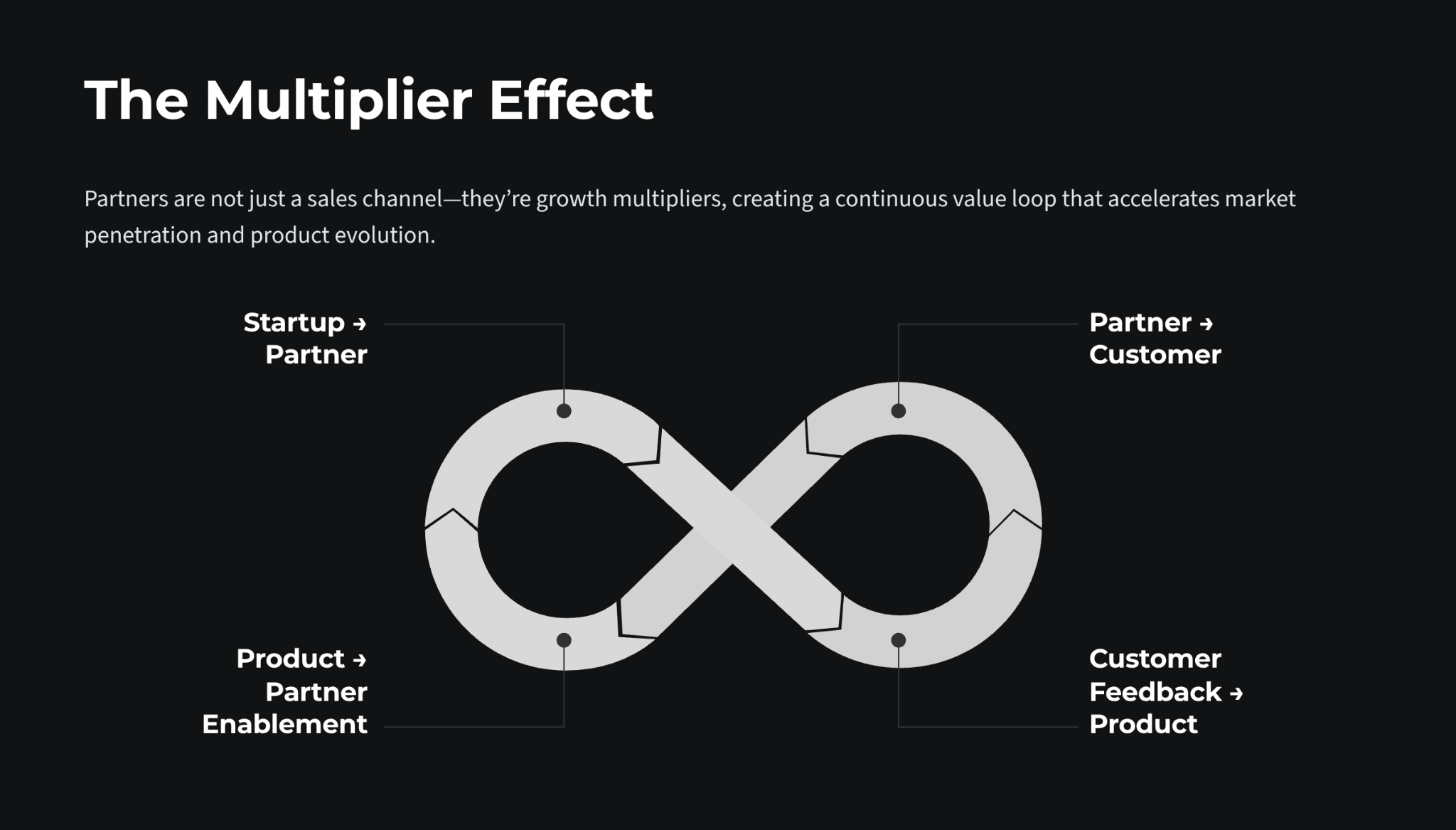
Q: How do you convince a founder that partners are not just a sales channel but a multiplier?
R. To truly benefit from an indirect GTM strategy, founders need to reframe how they think about partners. Partners aren’t just an extension of your sales arm- they’re a force multiplier across nearly every dimension of your business. A well-chosen partner ecosystem can:
- Amplify your brand: Established partners lend credibility and brand equity that startups often lack early on.
- Accelerate market access: They open doors to new geographies, customer segments and verticals that might otherwise take years to reach directly.
- Enhance customer experience: Many partners help deliver implementation, support and customer success- often at a fraction of the cost of building those functions in-house.
- Improve operational efficiency: From collecting payments to maintaining service levels and NPS, partners can streamline delivery and sustain quality.
- Drive continuous feedback: The best partners act as an external listening post, offering insights into customer sentiment, competitive dynamics and product improvement opportunities.
When founders view partners through this lens, they realize that these relationships multiply their reach, trust, efficiency and customer outcomes- not just revenue. So instead of asking “Why partners?” , the more strategic question becomes _“How can I engage the right partners early enough to make them an integral part of my GTM engine?”
Why Partners Need Startups
Q: What motivates partners to work with startups?
R: I often get asked, “Why do partners even need startups?”. If you look at the typical partner business model- whether a reseller, distributor or system integrator- their growth largely comes from one of two approaches:
- Selling more into existing accounts (deepening wallet share) or
- Selling to more customers (expanding market reach).
However, both models have inherent challenges. When partners continue selling the same set of products to the same set of customers, they face margin compression, competitive saturation and reduced differentiation. Over time, this erodes profitability and relevance. That’s where startups bring fresh opportunities. Startups often represent new technology categories, emerging solutions or cutting-edge innovations that established vendors may not yet offer. By collaborating with startups, partners can:
- Diversify their product portfolio, reducing dependency on legacy lines.
- Differentiate themselves in front of customers through innovation.
- De-risk their sales model by adding high-growth, high-margin solutions.
- Stay relevant to customers seeking the latest technologies.
In other words, working with startups helps partners future-proof their GTM strategy. It allows them to be seen not just as sellers, but as trusted advisors who bring the newest, most impactful technologies to their clients. For many partners, this alignment with innovation isn’t just strategic- it’s existential. Startups help them evolve with the market rather than fall behind it.
Q: How do mature partners assess whether a startup is ‘ready to partner’?
R: To understand how mature partners evaluate a startup’s readiness, it’s important to first appreciate who these partners are. Many of them have been selling to enterprise and mid-market customers for decades, representing some of the most established organizations in their regions. They engage with customers daily, understand evolving needs deeply and are constantly evaluating new technologies to stay competitive. When these partners assess a startup, they typically apply multiple lenses of evaluation- balancing customer relevance , commercial viability and sustainability.
1. Customer Demand & Market Relevance: The first and foremost question a partner asks is: “Does this solution add value to my customers?” They look for clear demand signals from their customer base- often surfaced during ongoing sales conversations. If customers are expressing a need for solutions in a category the startup operates in, it immediately increases partner interest.
2. Sustainable & Profitable Partner Model: A great product alone isn’t enough. Partners want to see a sustainable business model- one that ensures they can earn predictable margins, build repeatable motion and justify investment of their time and sales bandwidth. Startups often overlook this: partners are not in the business of selling your product alone; they are in the business of maximizing their own profitability. Hence, viability, sustainability and profitability are critical boxes to check.
3. Ability to Build Service Layers (“Services Wraps”): Partners assess whether they can create value-added services around your solution- implementation, integration, managed support- to increase stickiness and long-term revenue. The more extensible your solution, the more attractive it becomes to them.
4. Financial & Operational Stability: Even if the product is promising and in demand, a partner will hesitate if the startup appears financially unstable or lacks operational maturity. Since partners put their reputation and customer relationships on the line, they need confidence that the startup can sustain delivery and support commitments.
In essence, mature partners conduct rigorous due diligence before entering any alliance. They look beyond technology- evaluating the total business readiness of the startup:
- Is there genuine customer pull?
- Is the model partner-friendly and profitable?
- Can they build long-term value on top of it?
- And most importantly, is the startup stable enough to be trusted with their customer relationships?
Startups that proactively address these concerns during partner outreach dramatically increase their chances of building lasting, successful alliances.
Q: What do partners expect in return- margins, innovation access, co-marketing, support?
R: The answer is simple- partners expect all of them, though the degree of importance varies by their type and maturity. When a partner decides to represent your product in front of their customers, they are essentially extending their credibility on your behalf. In doing so, they expect access, enablement and support across multiple fronts.
1. Innovation Access & Product Insight: Partners expect visibility into your product roadmap and innovation pipeline. Since they are your first line of customer engagement, they need to understand what’s coming next, how the product differentiates and how to position it effectively. This level of access builds trust and equips them to act as confident advocates rather than intermediaries.
2. Enablement & Knowledge Transfer: Partners want to be self-sufficient when selling and supporting your product. This means startups must invest in structured enablement- through training, demos, playbooks and certification- so partners can operate independently while maintaining alignment with your core messaging.
3. Sales & Technical Support: Even the most capable partners need responsive backup- whether that’s pre-sales assistance, post-sale troubleshooting or joint solution design. Because partners sell on your behalf but don’t own the product IP, they rely on you for escalation and expertise when customer complexity arises.
4. Co-marketing & Brand Leverage: Strong partner programs offer co-marketing opportunities, joint campaigns, events or digital initiatives that amplify visibility for both sides. For startups, this is also a way to extend brand reach through the partner’s trusted market presence.
5. Sustainable Margins & Long-Term Profitability: Beyond short-term commissions, most partners look for sustainable, recurring and predictable margin models. They are less interested in one-off transactional deals and more focused on building long-term, profitable practices around your solution.
In essence, partners expect to be enabled, empowered and rewarded. If they can access innovation, operate confidently, sell profitably and grow alongside your brand- they will invest deeply in your success. The most successful partner programs are those that treat these expectations not as costs, but as shared commitments to mutual growth.
Q: How can startups make themselves more attractive to potential partners?
R: Many of the factors that make a startup ready to partner are the same ones that make it attractive to partners- but the starting point is always customer demand. The single most effective way for a startup to attract partners is to build a great product that solves a real problem- one that delivers a world-class customer experience and drives pull from the market. When customers begin asking their existing partners about your solution, that becomes the strongest signal of attractiveness possible. From there, several other factors reinforce partner interest many of which we discussed earlier:
- Clear Market Fit & Proven Use Case: Partners are drawn to startups whose products have demonstrated tangible results and relevance within their customer base. A clear use case reduces risk and increases confidence in joint selling.
- Sustainable, Partner-Friendly Business Model: Transparent pricing, fair margins and sustainable revenue models show that the startup understands how partners operate- making collaboration commercially viable and long-term.
- Enablement & Ease of Doing Business: Partners prefer startups that make it easy to sell and support their products- through well-defined onboarding, responsive support and a collaborative working relationship.
- Innovation & Services Potential: Startups with extensible solutions that allow partners to build service layers or integration opportunities around them are far more appealing, as they enable additional partner revenue streams.
- Credibility & Financial Stability: Finally, mature partners assess not just innovation but reliability. Startups that demonstrate sound governance, clear communication and operational consistency earn deeper trust.
In summary, partners are attracted to momentum- whether that momentum comes from customer demand, innovative technology or commercial predictability. When startups combine a great product with partner-ready operations , they stop needing to chase partnerships- the ecosystem starts seeking them out.
Startup Lifestage vs Partner Strategy
Q: How do you map startup maturity (0–1, 1–2, 3–5 years) to partner maturity or type?
R: In the initial phase of a startup’s journey (typically 0 to 1–2 years)- though this can vary depending on the product and market- the objective is not to build a revenue-driven partner network, but to find collaborative partners who can help shape and validate the product itself. At this stage, the product is often:
- New and untested,
- Undergoing iterations both in the lab and in early customer environments and
- Still searching for clear product-market fit.
The right partners during this phase are often called Design Partners- organizations or individuals willing to “stick their neck out” and co-develop or test your solution in real-world scenarios. Their role is far more than that of a buyer or seller; they are co-creators who provide candid feedback on what works, what doesn’t and what needs refinement. Instead of seeing them as revenue engines, founders should view design partners as collaborators in product development. They can help answer critical early questions such as:
- How does the product perform in production environments?
- What are customers’ actual needs versus assumptions?
- Where are the usability or value gaps?
Done right, these relationships can save hundreds of thousands of dollars (if not millions) in misdirected development and failed launches. Design partners accelerate learning, improve product-market fit and provide early validation that forms the foundation of scalable partner strategies later on.
Partner Strategy During the 2nd–3rd Year of the Product Cycle
By the second to third year of a startup’s journey, the product typically moves beyond the MVP stage. You have a validated offering, early customer adoption and a nascent brand presence in your target market. This is the stage where founders can begin shaping a more structured partner-led GTM strategy- shifting focus from product validation to market expansion. At this point, the startup should begin exploring which
GTM routes to double down on, but with discipline. A key rule of thumb, don’t pursue more than two to three ecosystem motions at a time.
Each partner motion- whether resell, co-sell, SI-led or influencer-driven- requires significant investment in enablement, pricing alignment and ongoing relationship management. When done incorrectly or spread too thin, these motions can consume valuable resources and dilute focus. E.g:
- If you’re pursuing a reseller or VAR motion, it’s best not to simultaneously activate a GSI motion, as both demand different levels of engagement, incentive structures and field alignment.
- Similarly, marketplace listings or MSP motions can be layered on later- once the foundational partner model has stabilized.
Ultimately, the right GTM combination depends on your resource strength, sales readiness and customer acquisition model. At this stage, success lies not in the number of partner routes you activate, but in how deeply and effectively you operationalize the few that align best with your market trajectory.
Partner Strategy Beyond the Third Year- Building a Mature Ecosystem
If your startup has sustained beyond the third year and is showing consistent growth in revenue, customer adoption and market presence, it’s time to evolve from ad-hoc partner engagement to a structured, multi-layered partner program. By this stage, your product has matured, your brand has credibility and your operational rhythms are more predictable. This creates the right foundation to design and implement a comprehensive partner strategy that aligns with your business objectives and customer segments.
- Building a Tiered Partner Program: A mature partner ecosystem typically includes different partner types serving distinct customer tiers. This could involve:
-
Global System Integrators (GSIs): For large enterprise or global accounts, particularly in industries such as BFSI, manufacturing or telecom, GSIs can drive transformation-scale implementations and strategic co-sell motions.
-
Regional or Specialized System Integrators (SIs): Ideal for vertical or geography-specific deployments where agility and domain expertise matter.
-
Value-Added Resellers (VARs) and Distributors: To scale reach across mid-market and SMB segments, offering volume and repeatability.
-
Consultants and Influencers: To evangelize the brand in emerging markets and shape buying decisions early in the customer lifecycle.
- Structuring Routes to Market (RTMs): At this point, you can divide your overall partner strategy into defined Routes to Market (RTMs)- each with its own enablement, pricing and governance model. Common RTMs include:
- Distribution: Focused on reach, scale and transactional efficiency.
- System Integrators(Global or Regional): Focused on solution depth, integration and enterprise-grade delivery.
- Resellers: Designed for speed of sale and transactional momentum and
- Marketplaces: Designed for digital scale and cloud(and now AI) delivery and consumption.
Each RTM should map to specific customer segments and product tiers- ensuring that every partner motion serves a distinct business purpose rather than overlapping efforts.
- Doubling Down on Strategic Alliances: At this maturity stage, startups can also begin investing in strategic alliances- deeper collaborations that go beyond resale. These may include:
- Technology Alliances: Co-building integrations or shared IP with complementary platforms.
- Hyperscaler Alliances: Leveraging AWS, Azure or GCP co-sell programs and marketplace listings for joint GTM.
- AI Alliances: Leveraging OpenAI, Anthropic, co-sell programs and marketplace listings for joint GTM as they build their programs
- Consulting or Advisory Alliances: Partnering with domain-specific experts to drive vertical expansion.
These alliances often require dedicated partner managers, joint business plans and co-funded marketing motions, but they unlock exponential reach and revenue potential when done right. In summary, by the time a startup crosses the three-year mark, it should transition from experimenting with partners to orchestrating a complete ecosystem- with clear segmentation, defined routes to market and differentiated engagement models for each partner type.
Q: What early signals show that a startup is ready to move from design partners to commercial partners?
R: In most cases, the signal for this transition doesn’t come from you- it comes directly from the partners. The shift from design partnership to commercial partnership is often seamless and natural, emerging as both the product and relationship mature. Typically, it begins when the initial proof-of-concept (POC) or pilot deployments with partners’ customers start transitioning into production-grade use cases. By this point, both the partner and their end customers have experienced:
- The capabilities of your product,
- The responsiveness of your team,
- The reliability of your support infrastructure and
- Your ability to deliver consistently in customer environments.
As confidence builds, partners begin to see repeatable commercial potential and start asking for formal proposals, pricing structures and go-to-market terms. This is the strongest indicator that your relationship has evolved beyond validation into commercial viability. Other measurable signals include:
- A noticeable increase in the number of POCs, showing growing interest.
- A reduction in support tickets related to bugs or product instability, indicating improved maturity.
- Partners initiating joint discussions around pricing, pipeline or customer expansion.
When these signs appear, it usually means the transition is already underway- your design partners are now ready to become your commercial advocates. You don’t have to force the shift; it happens organically through trust, performance and product credibility.
Q: How do you recommend founders prioritize partner types at each stage?
R: Partner prioritization should evolve in tandem with a startup’s maturity curve- both in terms of product readiness and operational capacity. Rather than trying to engage all partner types simultaneously, founders should focus on sequencing partnerships to match their current stage and strategic goals.
Stage 1: 0–2 Years- Validation & Co-Creation
Focus on Design Partners- early collaborators who help test, validate and refine your product. At this stage, prioritize:
- Partners who can provide real-world use cases and feedback
- Technology alliances (e.g., hyperscalers) that give credibility and infrastructure support,
- Select resellers or VARs for quick deployment or pilot opportunities. The goal here is learning and validation, not revenue.
Stage 2: 2–3 Years- Market Expansion & GTM Design
Once you’ve achieved product-market fit and early traction, shift focus toward commercial GTM partners. Choose no more than 2–3 routes to market to execute deeply and effectively- E.g:
- Resellers or VARs for mid-market reach
- Regional SIs for vertical or geography-specific adoption
- Hyperscaler GTM programs for joint marketing and co-sell leverage. This stage is about building repeatable, scalable motions- not overextending.
Stage 3: 3+ Years- Scale & Ecosystem Orchestration
With a proven product and growing revenue, move toward a structured partner ecosystem. This includes:
- GSIs for enterprise and global accounts,
- Distributors for scalable reach across markets,
- Consulting and Influencer Partners for thought leadership and demand creation
- Technology and Strategic Alliances to build integrated solutions and co-innovation.
Each partner type now serves a distinct purpose- validation, reach, delivery or influence and together they form a complete ecosystem flywheel that sustains long-term growth.
Q: Have you seen common pitfalls when transitioning from founder-led sales to partner-led GTM?
R: The truth is, there isn’t; and shouldn’t be- a sudden transition from founder-led sales to partner-led GTM. If the partner strategy has been thought through from the beginning, as it ideally should be, then the evolution happens naturally. The motion should ease into maturity rather than flip from one mode to another. However, where challenges often arise is in the mindset shift- particularly within internal sales teams.
- Perception of Partners as a “Drag”: One of the most common pitfalls is the belief among direct sales teams that a partner-led GTM motion is slower, less efficient or margin-dilutive. This stems from a transactional view of sales- focusing only on short-term deal velocity instead of long-term market reach and sustainability.
- Fear of Losing Pipeline Control: Another major friction point is the perception that involving partners means ceding control of the pipeline. Many founders and sales leaders worry that partners will “own” the customer relationship or visibility into deals, leading to loss of control. In reality, an effective partner-led GTM creates a shared ownership model, where both internal and external teams are aligned on goals, pipeline visibility and accountability.
- Internal Misalignment and Resistance: Transitions fail when sales and channel motions aren’t synchronized. Without clear communication and aligned incentives, internal teams may resist collaborating with partners- viewing them as competitors rather than force multipliers.
In essence, the biggest pitfall isn’t operational- it’s cultural. Founders must help their teams see partner-led GTM as a natural extension of their own success, not a replacement for it. When designed early and integrated thoughtfully, the shift from founder-led to partner-led growth becomes a smooth progression- not a handover.
Program Design and Enablement
Q: What should a ‘minimum viable partner program’ include?
When building a minimum viable partner program (MVPP), the first and most important principle to remember is this: It’s a program for your partners, not just for you. A partner program succeeds only when it’s designed as a mutually beneficial framework, not a control mechanism. If both sides see value- partners through tangible benefits and startups through scalable reach- the relationship flourishes.
1. Start with Purpose and Clarity: Before defining any requirements or benefits, be clear on what the program is trying to achieve. Ask:
- What is the primary goal of this program- awareness, activation, revenue or retention?
- What qualitative and quantitative outcomes are you aiming for?
- How does this program align with your broader GTM motion?
A clear sense of purpose helps shape every subsequent decision- from incentives to governance.
2. Structure Around Two Core Pillars: Every partner program, even at its earliest stage, should be built around two foundational pillars:
- Requirements: What partners must do to qualify, remain active or access specific benefits.
- Benefits: What they receive in return- in terms of margins, enablement or co-marketing.
Too often, startups design programs with misaligned or overly stringent requirements, especially early on. This deters partners who might otherwise engage enthusiastically. Requirements should be:
- Achievable but meaningful- creating skin in the game for both sides.
- Proportionate to the stage of your company- flexible early, more structured as you scale.
If your startup is still in its early phase, remember: You need the partners more than the partners need you. Your first version of the program should therefore be generous,
flexible and easy to engage with, allowing partners to see real returns from the start. You can always tighten criteria later as momentum builds.
3. Balance Qualitative and Quantitative Elements: An effective MVPP should have a healthy mix of both quantitative and qualitative elements:
- Quantitative Requirements: Sales targets, deal registrations, certification completions or training hours.
- Qualitative Requirements: Brand alignment, customer advocacy or engagement in joint marketing efforts.
- Quantitative Benefits: Discounts, rebates, MDF (Market Development Funds) or referral fees.
- Qualitative Benefits: Early product access, roadmap previews, co-marketing support or dedicated partner success resources.
This balance keeps the program structured enough to drive accountability yet flexible enough to nurture early trust.
4. Incentives Drive Behavior: As the saying goes, “incentives drive behavior” - and nowhere is that truer than in partner programs. Design your incentives to reinforce the behaviors that matter most to your business goals. For instance, if early adoption is your focus, incentivize deal registration and co-marketing. If retention is key, reward renewals or customer satisfaction outcomes.
In summary, a minimum viable partner program should be:
- Clear in purpose
- Simple to engage with
- Balanced in requirements and benefits and
- Generous enough to make early partners feel invested and rewarded.
Start flexible, scale responsibly and evolve the program in lockstep with your company’s maturity.
Q: How do you structure onboarding, enablement and certification at early stages?
R. The best way to think about onboarding and enablement in the early stages is to begin with clarity of focus- specifically, your Ideal Customer Profile (ICP).
1. Start with Your ICP- Let It Drive Partner Selection: Your ICP should be the north star for building your partner ecosystem. Before you onboard anyone, ask:
- Who is our ideal customer?
- Which geographies, verticals and segments do they belong to?
- What type of partners already serve those customers?
- What capabilities, competencies or reach do we need from partners to complement our strengths?
By anchoring onboarding decisions to your ICP, you naturally filter and qualify the right partners- those most likely to deliver real impact, rather than those who just want to “try it out.”
2. Design a Professional, Seamless Onboarding Experience: At this stage, you’re not just selling your product- you’re also selling your organization. Partners judge your seriousness by the professionalism and structure of your onboarding process. Unfortunately, many startups take an ad-hoc approach here- inconsistent communications, manual processes or lack of a central portal- which can erode trust early. Even simple investments in automation and tooling (a lightweight PRM or structured onboarding workflow) can go a long way. These tools create a frictionless experience for partners and convey the image of a well-organized, partnership-ready company. Remember:
The experience partners have during onboarding sets the tone for your entire ecosystem journey.
3. Focus on Enablement as a Growth Lever: Enablement is where your partner momentum is built. Early enablement should include:
- Product training tailored to different partner roles (sales, technical, marketing).
- Clear sales playbooks and positioning guides to help partners articulate your value proposition.
- Access to demo environments or use cases that make it easy for them to demonstrate value to customers.
The more self-sufficient your partners become, the faster they can generate results- and the less dependent they are on your internal teams for every deal.
4. Introduce Certification thoughtfully: Certifications add credibility but are not always practical in the early stages. If your product is highly technical or implementation-heavy, consider introducing basic competency certifications early- focused on sales and solution understanding rather than deep technical mastery. For others, certification can come
later, once there’s enough product maturity and partner depth to justify formal programs. Over time, a well-structured certification program becomes more than enablement- it becomes a branding asset. For successful startups, partner certifications often evolve into badges of honor that sales and technical professionals proudly display as part of their credentials.
In summary, a strong onboarding and enablement process is built on:
- ICP clarity,
- Professional experience,
- Targeted enablement and
- Evolving certification maturity.
When done right, these early investments create a solid foundation for long-term partner loyalty, confidence and advocacy.
Q: What role does technology (PRM, CRM, automation) play in managing partners effectively?
R: This is an area where many startups- and even established organisations- don’t think deeply enough. It’s often overlooked not because of negligence, but because there’s limited awareness about how much technology can transform partner management. Embracing automation early is one of the smartest decisions a startup can make if it wants to scale efficiently. Startups are inherently resource-constrained. Team members wear multiple hats- your salesperson may also be the channel account manager or your head of sales might double as your partnership lead. In such an environment, every manual task creates drag.
1. Why Technology Matters Early: Introducing automation early achieves two key outcomes:
- It enhances your image in front of partners- projecting professionalism and operational maturity.
- It amplifies productivity, enabling your limited team to manage a growing partner base without burning out.
In the early stages, even basic automation- structured onboarding workflows, centralized communication and real-time reporting- can dramatically improve efficiency and partner satisfaction.
2. CRM vs. PRM- Understanding the difference: Most startups begin with CRM systems (like HubSpot, Salesforce or Zoho). While these are great for managing customer relationships, they’re not built to handle the unique dynamics of partner engagement, such as deal registration, joint pipeline visibility, enablement content or MDF tracking. That’s where Partner Relationship Management (PRM) platforms come in. PRMs complement CRMs by providing purpose-built capabilities for:
- Partner onboarding and training,
- Co-selling workflows and deal registration,
- Lead and pipeline collaboration,
- Incentive and MDF management and
- Ongoing engagement analytics.
Even lightweight PRM tools can elevate partner experience by giving structure, transparency and scalability to your ecosystem efforts.
3. The Role of AI and Automation: The evolution of AI-led automation has further changed the game. A large portion of a channel manager’s daily work- updating pipeline data, tracking partner activity, sending follow-ups- is repetitive and administrative. Automating these tasks not only saves time but also frees up the channel team to focus on the work that actually matters- building and nurturing relationships. AI can also assist in partner discovery and prioritization, identifying ideal partners based on data signals like market presence, certifications or shared customer bases- allowing startups to make smarter, faster decisions.
4. The Takeaway: For startups, technology-led partner management isn’t optional- it’s an accelerator of scale. The earlier you integrate automation, PRM tools and AI-powered workflows, the easier it becomes to:
- Manage partners efficiently
- Maintain consistency in engagement,
- Project credibility and
- Scale with limited human resources.
Technology transforms partner management from a manual, reactive process into a data-driven growth engine.
Q: How can startups create partner tiers or scorecards without over-engineering them?
R: In the early stages of a startup’s journey, it’s generally not advisable to create complex partner tiers or heavily structured scorecards. Over-engineering the framework too early can confuse both your internal teams and your partners- especially when your GTM motion is still evolving. At this stage, your focus should be on building momentum and maintaining engagement, not on enforcing rigid structures.
1. Start Simple- Focus on Clarity, Not Classification: Rather than building multiple partner levels (e.g., silver, gold, platinum), early startups should aim to create a simple, transparent construct that:
- Communicates the spirit of the partnership,
- Outlines how partners can work with you and
- Keeps engagement warm and meaningful.
This basic structure should make partners feel valued and aligned, without burdening them or your team with unnecessary administrative layers.
2. Evolve Structure Post- Product Market Fit: Once your startup has crossed the MVP and PMF milestones and your partner ecosystem begins to scale, it becomes more practical to formalize tiers or performance scorecards. At this stage, you’ll have clearer data around:
- Which routes to market are performing
- What kind of partners deliver the most value
- How to align benefits and requirements accordingly
Formal structures such as tiered benefits, achievement-based rewards or performance metrics should be introduced only when the business has reached a level of maturity.
3. Align with Startup Lifecycle and GTM Maturity: As discussed in earlier sections, each stage of a startup’s lifecycle can have its own partner strategy and routes to market. Your tiering and scoring models should evolve in sync with that journey starting from broad collaboration models (design partners, early adopters) to more formal partner programs with defined benefits, revenue targets and enablement criteria.
A lightweight, transparent program in the early days signals openness and flexibility while a more formal, data-driven model introduced later ensures fairness, motivation and accountability as your ecosystem grows.
Partner Compensation and Governance
Q: What incentive models are the most effective for early vs. mature programs?
R: Whether at an early or mature stage, effective incentive models always strike a balance between what you want to achieve through the partner program and what partners expect in return. The most successful models align qualitative and quantitative requirements with qualitative and quantitative benefits ensuring fairness, clarity and mutual value.
1. Simplicity Above All: The best-designed incentive programs are also the simplest. If a partner representative can’t understand your program within the first five minutes, it’s probably too complex. Complexity creates confusion, slows execution and leads to partner disengagement. A good rule of thumb:
“If it takes a training deck to explain your incentive model, it’s too complicated.”
Simplicity also extends to consistency of messaging. Incentives and program terms should not change midstream; stability builds trust, while shifting rules erode confidence.
2. Flexibility and Dynamism: Rigid, one-size-fits-all programs often become liabilities over time. Markets change, partner priorities shift and customer cycles evolve so your incentive structure must allow for flexibility within clear guardrails. Programs that permit some degree of customization or adaptive rewards perform better because they can evolve with both the partner ecosystem and your business objectives.
3. Minimize Subjectivity and Discretion: The less subjective or discretionary a program is, the more partners will trust it. Incentive models that rely heavily on internal approvals or opaque decision-making discourage participation. Strive for objective, transparent qualification criteria and clearly measurable milestones.
4. Early-Stage Incentive Models: In the startup’s early phase, when both the product and market are still evolving, incentive programs should be simple, financial and milestone-based. Common approaches include:
- Fixed margin structures or transfer-price-plus models,
- Deal-based payouts tied to registered or closed opportunities and
- Performance bonuses for first wins or early customer success stories.
At this stage, avoid overly qualitative components- the goal is to drive adoption and momentum while you’re still learning.
5. Mature-Stage Incentive Models: As the ecosystem grows and both partners and internal processes mature, you can transition toward hybrid incentive structures that blend financial and qualitative levers, such as:
- Tiered margin programs based on volume or certification level,
- MDF (Market Development Funds) for co-marketing or events,
- Rebates linked to customer retention or renewals and
- Non-financial rewards like early product access, roadmap participation or partner-of-the-year recognition.
This evolution moves the conversation from short-term payouts to long-term partnership value.
6. Key Takeaway: Incentive models work best when they are:
- Simple to understand,
- Consistent in messaging,
- Flexible to evolve and
- Transparent in execution.
In early stages, keep it transactional and clear. As you grow, layer in qualitative and strategic components that encourage deeper alignment, advocacy and shared success.
Q: How do you balance transparency with flexibility in partner rewards?
R: Transparency is one of the most critical elements of any partner reward or incentive structure for two key reasons:
- It involves financial transactions with external entities, which must always be above board.
- The foundation of any strong partner relationship is built on openness, trust and credibility.
When partners can clearly understand how rewards are calculated, what qualifies for them and when they’ll be paid, it builds confidence and long-term alignment.
1. Transparency Builds Credibility: Transparent programs where qualification criteria, payout terms and measurement metrics are clearly communicated not
only instill confidence in partners but also enhance your credibility within the ecosystem. It signals professionalism and maturity and it reduces friction during execution. The more transparent a program is, the less discretionary it needs to be. This minimizes ambiguity, prevents bias and ensures that partners feel they’re being treated fairly and consistently.
2. Flexibility Sustains Relevance: While transparency provides the structure, flexibility ensures adaptability. Partner programs operate in dynamic markets, customer priorities shift, new opportunities emerge and occasionally, the program design must pivot for the collective good. A well-designed program should therefore allow for reasonable adjustments without eroding the underlying trust. E.g:
- Temporary incentive boosts for new market entries,
- Adjusted qualification thresholds due to external factors or
- Revised payout timelines during product launches or major transitions.
3. Balancing the Two: The key is finding the right balance between clarity and agility. Be transparent in the intent and process, while staying flexible in the execution. Partners should know that while the core principles of fairness and openness never change, the operational details can adapt to serve shared objectives.
4. The Outcome: Striking this balance helps you build not just a compliant and efficient rewards model, but also a reputation as a mature, empathetic and trustworthy partner organization one that values both integrity and partnership outcomes. In essence: Transparency earns trust; flexibility sustains it.
Q: What metrics define success- partner-sourced revenue, influenced pipeline, activation time?
R: The definition of success metrics in a partner-led GTM depends heavily on the stage of the startup and the maturity of the ecosystem. For startups in particular, clarity on what success means and when is critical. Metrics that make sense in the first year may no longer be relevant two years later.
1. Early Stage (0–2 Years): Validation and Activity Metrics: In the initial phase, when the focus is still on validation and product-market fit, success should be measured through engagement and proof metrics, not just revenue.
Examples include:
- Number of Proofs of Concept (POCs) initiated or completed through partners,
- Customer interactions or demos facilitated by partners,
- Active partner participation in pilot programs or joint marketing,
- Early feedback loops that improve the product’s market readiness.
At this stage, partners serve as co-creators and validators- so the success of the ecosystem lies in traction and learning, not volume.
2. Growth Stage (2–3 Years): Pipeline and Influence Metrics: As the product gains adoption and credibility, the metrics begin to shift toward pipeline creation and revenue influence. Here, you start tracking metrics such as:
- Partner-influenced pipeline- deals where partners contributed to shaping customer demand or influencing the decision
- Partner-sourced opportunities- net-new deals initiated by partners,
- Activation rate- how many onboarded partners are actively driving activity
- Conversion rate of POCs to production deployments.
This stage marks the evolution from validation to scalability. Partners begin to drive measurable impact on growth.
3. Mature Stage (3+ Years): Revenue and Retention Metrics: Once the ecosystem is established, success is defined by sustained business outcomes and ecosystem health. Key metrics now include:
- Partner-sourced revenue (deals fully led by partners),
- Partner-influenced revenue (jointly executed deals),
- Renewal and retention rates for partner-acquired customers,
- Partner ROI- the revenue partners generate relative to their enablement investment
- Ecosystem contribution ratio- the percentage of total revenue influenced or sourced through the partner ecosystem.
At this stage, success means partners are not just generating deals, but delivering consistent, incremental and renewal-based growth.
4. Balancing the Mix: Over time, startups should develop a blended scorecard that combines:
- Partner-led deals (sourced and closed by partners),
- Partner-executed deals (led by you, fulfilled by partners) and
- Hybrid deals (jointly developed and executed).
Each contributes differently to growth and the balance evolves as the ecosystem matures. The ultimate goal is a self-sustaining mix of partner-sourced, influenced and retained business that compounds over time.
In summary, metrics must evolve with maturity- from activity to influence to outcomes. Early-stage success is measured in engagement and validation ; mid-stage in pipeline creation ; and mature-stage in revenue, retention and partner-driven scale.
Q: How do you handle partner conflict or deal-registration overlaps in early programs?
R: When it comes to managing partner conflicts, the operative word- once again is transparency. One of the biggest mistakes organizations make, especially in the early days of ecosystem building, is not being transparent or communicative enough with partners. In most cases, partners are experienced professionals and mature organizations. They understand that conflicts and overlaps are inevitable as multiple partners may pursue similar opportunities or work with the same customer segments. What they don’t tolerate well is uncertainty, ambiguity or lack of information.
1. Transparency Prevents Escalation: The majority of partner conflicts stem from information asymmetry. When partners feel they’re not being informed or when deal ownership isn’t clearly communicated, trust erodes. By maintaining transparency in opportunity registration, lead assignment and pipeline visibility you prevent small issues from escalating into relationship-damaging disputes.
2. Communication Resolves More Than Policy: Even the best-designed partner programs can’t anticipate every overlap or edge case. That’s why consistent communication is more powerful than complex rules. If you proactively communicate with partners about potential overlaps or policy exceptions, most issues resolve before they escalate. A timely, honest conversation can often do more than a rigid policy manual.
3. Early-Stage Context- Keep It Simple: For early-stage startups, partner conflict and deal registration are typically less frequent issues, simply because the partner base is smaller. However, this is the ideal time to set expectations early:
- Define the modus operandi for collaboration.
- Establish how deal registration will work (if applicable).
- Make it clear how leads are assigned or shared.
- Reinforce the value of openness and trust as cultural pillars of your ecosystem.
Doing this from day one not only prevents future friction but also helps you build a reputation for fairness and transparency within the partner community.
4. The Takeaway: Conflicts are not a sign of failure- they’re a natural byproduct of growth. What defines successful partner management is how you handle them. When partners see you as transparent, communicative and fair- even in tough situations- your credibility in the ecosystem multiplies.
Transparency avoids conflict; communication resolves it.
Roles and Ownership
Q: What is the founder’s role in ecosystem building during the first two years?
R: In the initial years of a startup, founders play an absolutely critical role in ecosystem building. During this period, the organization largely revolves around the founder- most strategic decisions, directly or indirectly, are shaped by their vision, endorsement and involvement. That’s why the decision to build an ecosystem and invest in partnerships must have the explicit backing of the founders. Partnerships cannot be treated as a peripheral or experimental activity; they have to be baked into the go-to-market strategy from day one.
Ecosystem building is not an afterthought- it’s a strategic choice that should be discussed and owned at the board or CXO level. When founders visibly champion the partner motion, it sends a powerful signal across the organization that this is not just another sales initiative but a core pillar of business growth.
Their endorsement ensures that:
- Internal teams align around the vision of ecosystem-led growth,
- Partners gain confidence in the company’s long-term commitment and
- The culture of collaboration and transparency becomes embedded early in the company’s DNA.
In essence, the founder’s early involvement and advocacy give legitimacy, direction and velocity to the entire partner strategy.
Q: When is the right time to hire a dedicated partner manager and what profile works best?
R: This is one of the most critical and most misunderstood decisions in building a partner-led organization. Many startups make the mistake of hiring a partner manager either too early or too late and both can set the individual and the program up for failure.
1. The Risk of Hiring Too Early: Hiring too early often leads to frustration- both for the partner manager and the company. If the product-market fit (PMF) is still uncertain, the GTM motion undefined or the roadmap still fluid, a partner manager will struggle to engage partners meaningfully. Partners dislike ambiguity; if your representative can’t
confidently articulate the product’s positioning, roadmap or ideal customer, the ecosystem quickly loses trust.
2. The Risk of Hiring Too Late: Conversely, waiting too long can be equally damaging. By the time the organization matures and habits are set, it becomes harder to build the partner-first culture that should have been seeded early. Best practices such as deal registration, joint pipeline management or partner enablement are much harder to retrofit after the fact.
3. The Right Timing: The ideal time to hire a dedicated partner manager is once you start seeing early product-market validation typically around the end of the first year after launch, when you have:
- A handful of paying customers
- Clear visibility into target segments and use cases and
- Initial confidence in your partner strategy and GTM direction
Before that stage, it’s perfectly fine for founders or early sales leaders to own partnerships in a shared capacity, especially when the focus is still on design partnerships or initial co-sell motions.
4. The Ideal Profile: The right partner manager at this stage should be:
- Entrepreneurial and resourceful comfortable operating in ambiguity,
- Commercially savvy understands both sales and relationship management,
- Cross-functional able to work with product, sales and marketing teams and
- Empathetic toward partners capable of building trust while balancing startup realities.
In short, hire your first dedicated partner manager once the foundation is steady but before growth outpaces structure. That timing ensures the person can scale what’s working, institutionalize best practices and build a healthy partner motion rather than firefighting or waiting for clarity that never arrives.
Q: How do you align internal teams (sales, marketing, product) around the partner motion?
R: The most effective way to align internal teams whether sales, marketing or product is to make them understand that partners are not an alternative sales motion, but a parallel go-to-market motion. Partners exist to amplify and complement what internal teams are already doing, not to compete with them.
1. Addressing the Mindset Challenge: One of the first hurdles in partner alignment is internal perception. Sales teams, in particular, sometimes see partners as competitors who might “take over” their deals or dilute their control over the pipeline. The reality, however, is the opposite: Partners expand your reach, multiply your market presence and make the core sales motion more scalable- not redundant. It’s the responsibility of the channel or alliance leader to continually reinforce this message and demonstrate- not just tell- how the partner ecosystem amplifies everyone’s outcomes.
2. Demonstrate the Multiplier Effect: The best way to change internal perceptions is through demonstration and data, not messaging alone. E.g: If your startup has a 10–15 person sales team and you onboard 15–20 partners each with two or three salespeople promoting your product- you’ve effectively created a 100-person sales force representing your brand in the market. That’s the network effect of a partner-led GTM and when internal teams see it in action, alignment follows naturally.
3. Aligning with Marketing: From a marketing standpoint, the same principle applies. Every partner- large or small- brings with them their own marketing muscle, customer base and branding channels. The goal isn’t “our marketing versus theirs,” but our marketing with theirs. When partners and your marketing team co-create campaigns, co-host events or share digital content, the combined reach and credibility multiply exponentially.
4. Engaging Product and Support Teams: For product and support teams, alignment comes through feedback loops. Partners act as a valuable extension of your product intelligence- bringing insights from real-world customer usage, unmet needs and competitive dynamics. This feedback can accelerate your product roadmap and make your support operations more customer-centric.
5. The Core Principle: The alignment between internal teams and partners thrives when everyone understands one truth. Partners are not here to take your job- they’re here to make your job more impactful. Once that mindset shifts, collaboration replaces competition and the organization begins to operate as one unified ecosystem- internally and externally.
Q: What governance or review rhythm keeps the program healthy (QBRs, scorecards, dashboards)?
R: In the early days of a startup’s partner journey, it’s best not to over-engineer
governance structures. At this stage, the goal should be to build warmth, trust and rhythm in the relationship- not to impose formality or bureaucracy. That said, even in the early phase, it’s essential to have a governance model, however lightweight, to keep communication consistent and expectations clear.
1. Early Stage: Keep It Flexible and Conversational: When your ecosystem is young, your focus should be on keeping communication lines open. You don’t necessarily need formal Quarterly Business Reviews (QBRs), detailed dashboards or scorecards. Instead, define a mutually agreeable cadence- weekly, monthly or quarterly- depending on the intensity of engagement. At this point, flexibility is key. As mentioned earlier, you need the partners more than they need you, so the framework should be adaptable and mutually beneficial. The objective isn’t to audit performance but to nurture collaboration and alignment. The single most important element of early governance is communication consistency. Lack of communication has killed more partnerships than lack of performance.
2. Maturing Stage: Introduce Structure and Accountability: As both your ecosystem and the scale of engagements grow, governance must evolve into a more structured and cross-functional framework. This is particularly important when:
- The partner’s performance begins to directly impact your business outcomes and vice versa.
- Both sides have dedicated teams across sales, marketing, pre-sales, delivery and support.
At this stage, it’s critical to establish:
- Formal QBRs or MBRs (Monthly/Quarterly Business Reviews) with clear metrics and KPIs.
- Scorecards or dashboards tracking joint pipeline, enablement progress and revenue contribution.
- Executive sponsors from both organizations to ensure top-level alignment and escalation channels.
3. The Transition Trigger: That’s the inflection point where the relationship moves from transactional to strategic. Governance becomes not just a reporting tool but a relationship health framework that ensures both sides stay synchronized, accountable and growing together. Start light and conversational, evolve to be structured and measurable and always remember: governance is not control- it’s continuity.
Scaling and Evolution
Q: How does the ecosystem evolve as startups expand globally (e.g., US, LATAM, APAC)?
R: Most startups begin their expansion journey organically- following early success in their local or regional markets. But when it comes to global expansion, ecosystems play a disproportionately powerful role in helping startups scale beyond their immediate geography. Expanding internationally isn’t just about hiring teams abroad; it’s also about navigating local complexities- cultural, operational and regulatory. This is where partners become invaluable. They help bridge the gap between your early traction and sustainable global presence.
1. Partners as Recon Agents: The best way to think about partners in new geographies is as your recon agents- the first line of intelligence and market validation. They help you:
- Map the market and identify target customer segments
- Land your first 5–10 customers with minimal risk and overhead
- Provide local insights on what messaging, pricing or positioning works
- Navigate language and cultural nuances
- And even manage commercial logistics- such as collections, fulfillment and compliance.
In a nutshell, they help you test and land before you expand and scale.
2. Leveraging Mutual Brand Equity: As your startup matures, the dynamic between you and your partners becomes mutually reinforcing.
- Early on, you piggyback on your partners’ local presence and reputation to establish credibility and reach.
- As your brand gains traction, partners in turn leverage your brand strength to win new business and expand their own portfolio.
This creates a reciprocal flywheel of credibility- your growth fuels theirs and their local trust fuels your entry.
3. Scaling the Ecosystem as You Grow: Over time, the ecosystem naturally evolves in sophistication and reach:
- Phase 1: Local distribution or referral partners who help you get initial traction.
- Phase 2: Regional or vertical specialists who deepen market penetration.
- Phase 3: Global system integrators (GSIs) and strategic alliances who help drive enterprise-scale expansion.
Each stage builds on the last- starting with tactical entry and evolving into strategic, high-value partnerships as both brand and capability maturity increase.
4. The Core Insight: When expanding globally, think of partners not as intermediaries but as market accelerators. They bring you market intelligence, speed and trust- three assets that are incredibly difficult and expensive to build organically in new geographies.
Your ecosystem is your early global team- your eyes, ears and hands in new markets.
Q: What does a ‘mature ecosystem flywheel’ look like?
A mature ecosystem flywheel is one in which every point of entry into the ecosystem leads to growth- for the startup, for partners and for customers. It is a continuously self-reinforcing system where demand and supply feed each other in a virtuous loop.
1. The Self-Reinforcing Cycle: Think of the flywheel as a network with multiple points of entry- partners, customers and the product itself. Each of these feeds energy into the system and the more momentum the ecosystem gains, the faster it accelerates growth.
- As the product gains adoption, more partners want to associate with it.
- As partners take the product to market, they create more customer demand.
- As customer demand increases, new partners are drawn in, strengthening the ecosystem further.
This creates a continuous cycle where product growth fuels ecosystem growth and ecosystem growth fuels product growth- a true symbiotic motion of mutual expansion.
2. The Demand–Supply Interlock: In a mature ecosystem:
- Partners create demand by evangelizing and delivering your product
- Customers amplify demand by asking for the product through trusted partners
- The startup sustains supply through continuous product innovation and enablement
Over time, this interlock ensures that the ecosystem becomes self-propelling- the more mature and widespread it becomes, the less dependent it is on direct intervention from the startup.
3. Balanced, Multi-Route Growth: Another sign of maturity is balance. You’re no longer dependent on a single GTM motion or geography. Instead, you have:
- Multiple routes to market (e.g., GSIs, VARs, distributors, marketplaces),
- Both direct and partner-led sales motions working in harmony and
- A culture where internal and external teams collaborate seamlessly, without territorial friction.
At this stage, your growth becomes co-dependent- your partners’ success directly drives yours and vice versa.
4. Cultural and Behavioral Maturity: Perhaps the clearest marker of a mature ecosystem is shared ownership. When partners start treating your product as their own business, advocating for it, investing in it and innovating around it- that’s when the ecosystem has truly taken root. The goal of every startup should be to reach a point where partners sell, market and deliver with the same conviction and accountability as your internal teams. When that happens, the ecosystem ceases to be a function- it becomes a growth engine.
A mature ecosystem flywheel is a state where growth begets growth. Your product drives partner success, partner success drives market demand and market demand strengthens your product’s adoption- creating a continuous, compounding cycle of scale.
Q: What emerging trends will reshape indirect GTM in the next 3–5 years?
The single biggest trend that will reshape indirect GTM over the next three to five years is the advent and acceleration of Artificial Intelligence (AI). AI has the potential to fundamentally transform how partner ecosystems operate- from strategy to execution-
by enhancing productivity, eliminating inefficiencies and enabling smarter, data-driven collaboration across the entire value chain.
1. AI as a Structural Disruptor: AI is already upending established business models, both for vendors and partners. It is impacting every dimension of the ecosystem- sales, marketing, support, delivery, pre-sales and post-sales- blurring traditional boundaries between roles and functions. For many, it represents both an opportunity and a challenge. But when used strategically, AI can dramatically amplify the speed, precision and reach of partner motions.
2. Automating the Mundane, Amplifying the Human: Much of today’s partner GTM still involves manual, repetitive and low-value work- data entry, pipeline updates, reporting and documentation. AI can automate these laborious workflows, freeing up partner and channel teams to focus on what truly matters: relationship building, strategy and customer impact. This shift from administration to intelligence will redefine productivity metrics
- Implementation cycles can reduce from months to weeks
- Sales enablement can become personalized and real-time
- Data updates and insights can move from days to minutes
These compounded productivity gains will fuel the next stage of ecosystem growth.
3. AI as the New Growth Engine: When embedded across the partner lifecycle- from discovery to enablement to governance- AI becomes a growth multiplier. It can help:
- Identify ideal partners faster through predictive analytics,
- Match opportunities to partner capabilities dynamically,
- Personalize enablement and content delivery at scale and
- Predict partner performance and risk using behavioral data.
In short, AI shifts indirect GTM from reactive management to proactive intelligence.
4. The Mindset Shift: As with any technology, the challenge is not AI itself- it’s how we choose to use it. AI should not be viewed as a threat to human roles but as a catalyst for human effectiveness. The organizations and ecosystems that adopt AI with the right mindset- focused on augmentation, not replacement- will lead the next wave of indirect GTM transformation.
5. The Outlook: In the next few years, AI will do for indirect GTM what cloud did for infrastructure to make it faster, smarter and infinitely more scalable. AI will not replace the partner manager- but it will empower the partner manager to do 10x more, 10x faster. When applied thoughtfully, AI will become the engine that powers the next generation of ecosystem-led growth.
Case Studies and Frameworks
Case Study 1: Building a Distribution-Led Partner Ecosystem
One of the most impactful use cases I’ve been closely involved in is that of a large cybersecurity SaaS and AI company, which began building its partner ecosystem roughly two years ago. At that time, the company had no existing partner framework- it started from zero. Today, that ecosystem has grown to include over 300 partners globally.
1. The Strategy: Starting with a Distribution-Led Model
From the very beginning, the company made a deliberate choice to adopt a distribution-led ecosystem strategy. Rather than trying to build individual relationships with dozens of resellers, it focused on a small number of strategic distribution partners- such as Redington, Tech Data and key regional distributors.
This model created a structured layer of leverage:
- The distributor became the primary orchestrator, responsible for onboarding and managing downstream resellers.
- The vendor focused on training and enabling the distributors, who in turn cascaded knowledge and sales readiness across their networks.
2. The Advantage: Scale Through Leverage
The biggest advantage of this model was scalability without loss of focus. By concentrating efforts on just two to four distributors, the company could drive:
- Consistent enablement and messaging,
- Better partner qualification and filtering and
- A faster multiplier effect through downstream networks.
The distributors also brought their own market intelligence and relationships, allowing for smarter partner selection and faster go-to-market execution.
3. Execution: Balancing Scale with Visibility
While the distributors managed onboarding and operations, the company maintained direct engagement with key downstream partners. This ensured that the brand stayed
visible, relationships remained warm and product feedback flowed back to the core team. Over time, the distribution layer became a self-sustaining engine- capable of driving lead generation, revenue growth and partner expansion with limited direct intervention from the vendor.
4. The Outcome: A Self-Sustaining Growth Engine
Within two years, the program evolved from a zero-partner base to a fully functional, independently scaling ecosystem. Today, it serves as a lead-generation and revenue-generation engine, with the distributors acting as true ecosystem multipliers- extending reach, enabling partners and sustaining growth autonomously.
A distribution-led model allows startups- especially in fast-moving domains like cybersecurity to scale partner reach exponentially while keeping operational complexity manageable. When executed well, it becomes a flywheel of enablement, influence and scale.
Case Study 2: Building a High-Quality, SI-Led Partner
Ecosystem
The second case I’d like to highlight is that of a highly innovative Indian startup that is rapidly gaining traction across global markets. Unlike many startups that rush to scale their partner numbers, this company took a measured and strategic approach- choosing to focus on a small set of high-quality system integrators (SIs) and enterprise partners rather than chasing volume.
1. The Strategy: Quality Over Quantity
From day one, the leadership was clear: success would come not from the number of partners, but from the depth and quality of each relationship. Even before the product was launched, the Founder & CEO approached me with a clear mandate:
“We may not have the product today, but when we do, I don’t want to be wanting in terms of partner readiness.”
Starting partner engagement before product launch- with a focus on readiness, alignment and enablement- creates a faster, smoother path to scale once the product enters the market.
2. Early Engagement and Market Seeding
Long before product release, the company started warming up the ecosystem by:
- Reaching out to select SIs and enterprise partners to understand their needs, customer priorities and pain points,
- Conducting exploratory discussions and pitch sessions to collect structured feedback and
- Mapping out competitive offerings to position their eventual launch strategically.
By the time the product was ready, the company had already established relationships, trust and a ready audience among its ideal partner base.
3. Launch Readiness and Partner Experience
When the product was launched, partner readiness ran in parallel.
- All partner collaterals, assets and playbooks were ready at the same time as the product GTM.
- The company deployed partner tools and automation systems early to ensure a professional and seamless experience for onboarded partners.
- Within a year, they had onboarded around 50 partners- a modest number by count, but extremely strong in quality and relevance.
These partners have since become a consistent source of high-value leads and opportunities, driving strong early traction in global markets.
4. Internal Alignment: Enabling Sales and Channel Harmony
Another key success factor was internal alignment. The sales team was sensitized early to the partner GTM motion, ensuring there was no internal friction or territorial behavior. This alignment allowed direct and indirect motions to operate as parallel, complementary tracks, reinforcing each other rather than competing.
5. The Outcome: A Foundation of Strategic Depth
Within a year of launch, this startup built a compact yet powerful ecosystem anchored around select SIs and direct resellers. The result was a high-quality, high-trust partner
network that delivered meaningful leads, influenced enterprise opportunities and expanded global visibility.
Case Study 3: Scaling Globally Through a Hybrid
Partner and Marketplaces
The third case study comes from a global technology company that began as an internal product use case and later evolved into a commercial offering. When the company decided to scale this product globally, it approached the initiative with a startup mindset- limited resources, lean teams and an experimental approach- but with the discipline of an enterprise.
1. The Strategy: Building a Hybrid Ecosystem
Recognizing that no single GTM route would suffice, the company adopted a hybrid partner ecosystem model. This approach combined:
- Traditional routes such as System Integrators (SIs), Global System Integrators (GSIs) and resellers, to provide reach, delivery and customer engagement and
- A digital route through Google Cloud Marketplace, enabling frictionless global selling and distribution.
This blend allowed them to capitalize on both relationship-driven enterprise sales and digital-led, self-service growth.
2. Execution: Parallel GTM Motions with Clear Ownership
While many startups struggle to manage even one partner motion, this company successfully executed multiple GTM motions in parallel by:
- Assigning clear ownership to each motion (SI, GSI, reseller and marketplace).
- Creating aligned enablement programs tailored to each partner type.
- Using centralized governance and technology platforms to maintain visibility across all routes.
Because they had the necessary scale, funding and operational maturity , they could orchestrate these multiple channels without internal chaos.
3. The Marketplace Advantage
The Google Cloud Marketplace became a critical pillar of their growth. It provided:
- Instant access to a global customer base already within the cloud ecosystem,
- Simplified procurement and billing, especially for enterprise buyers and
- Seamless integration with existing cloud consumption models, which accelerated deal closure.
The marketplace motion complemented the partner ecosystem perfectly- offering reach where direct sales teams or resellers had limited presence.
4. The Outcome: Global Reach, Unified Growth
Through this hybrid model, the company was able to:
- Rapidly expand its global partner network,
- Accelerate customer acquisition through both physical and digital routes and
- Build a sustainable global distribution engine that scales across multiple GTM layers.
This success demonstrates that when executed with clarity and orchestration, multiple partner motions can coexist and reinforce one another- each amplifying the other’s strengths.
A hybrid model- combining traditional partner networks with digital marketplace distribution- represents the future of scalable, global ecosystem-led growth. With the right balance of resources, structure and technology, startups and enterprises alike can turn diverse routes to market into a cohesive global flywheel.
Q: What lessons did you learn from failed or underperforming partnerships?
R: Over time, I’ve learned that most partnerships don’t fail because of underperforming partners- they fail because of misalignment, mistiming or misfit. When a partnership doesn’t deliver, it’s rarely about capability or intent. It’s usually about whether the right partner was chosen at the right stage of the company’s evolution.
1. Partner Selection and Fitment: One of the most common causes of partnership failure is poor fitment. The partner may be excellent in their domain but not suited to your product’s maturity, pricing model or customer profile. A highly enterprise-focused partner may not be ideal for a startup still targeting mid-market segments, for instance.
In other cases, the product may have been too nascent for the partner’s ecosystem- leading to a mismatch in expectations and execution capability.
2. Timing of Partnership Launch: Timing is equally critical. Launching a partner program too early- before the product, pricing or positioning is fully defined- often leads to frustration. If partners can’t clearly articulate your value proposition or differentiate your product against established competitors, they lose motivation quickly. A premature partner launch can therefore erode trust and momentum, even before it has the chance to mature.
3. Speed and Consistency of Execution: Even when the partner fit and timing are right, slow or inconsistent execution can derail progress. Startups often underestimate the operational intensity of partner management. Under-resourced teams- where the same person is handling partnerships, sales and enablement- can unintentionally become a bottleneck. And while technology enables scale, partner engagement still depends heavily on human interaction. Face-to-face conversations, regular touchpoints and timely support remain critical to sustaining confidence and momentum.
4. The Core Lesson: Fitment Over Fault: In reality, there’s rarely such a thing as an underperforming partner - only a wrongly identified or poorly timed partnership. When partners are onboarded with the right fit, clear value articulation and adequate enablement, performance almost always follows.
Partnerships fail not because people fail- but because alignment, timing or structure does.
Partnership Maturity Index
The Partner Maturity Index (PMI) guides startups to build partnerships with intentionality, timing and fitment.
Q: The Partner Maturity Index (PMI)
R: I am happy to introduce a framework called Partner Maturity Index (PMI)- a model that helps startups align their partner engagement strategy with their own stage of maturity. The PMI acts as a guiding compass for founders and GTM leaders, helping them determine what kind of partners to pursue, what type of engagements to design and what level of investment to make at each stage of their journey.
1. Purpose of the Partner Maturity Index: Startups often struggle to determine when to start building partnerships, what type of partners to prioritize and how much structure to impose. The Partner Maturity Index solves this by offering a stage-by-stage blueprint that ties together:
- Startup readiness (product maturity, market traction, revenue stage) and Partner strategy (type, role, engagement depth and enablement model)
2. Why the PMI Matters: The Partner Maturity Index enables startups to:
- Avoid premature scaling of partner programs,
- Identify the right partner archetypes at each phase,
- Build structure progressively without over-engineering and
- Measure readiness and ecosystem health systematically.
In essence, it acts as both a diagnostic and prescriptive tool- showing where you are on the partner maturity curve and what to do next. It ensures that partner ecosystems grow in lockstep with product and organizational maturity- turning ecosystem building into a predictable, repeatable discipline.
Partner Maturity Index-Startups
| Startup Stage | Focus | Ideal Partner Profiles | Engagement Depth | Key Outcomes |
|---|---|---|---|---|
| Stage 1: 0–2 Years (Product Validation) | Product-market fit, design feedback | Design Partners | High-touch, co-development | Product validation, early credibility |
| Stage 2: 2–3 Years (Market Expansion) | Scaling GTM, pilot partnerships | VARs, Regional SIs, Resellers | Moderate-touch, commercial GTM | Pipeline creation, early partner-led deals |
| Stage 3: 3–5 Years (Ecosystem Growth) | Formalized programs, reach expansion | Hyperscalers, Distributors, GSIs, Co-sell Alliances | Structured engagement, defined benefits | Scalable ecosystem, revenue diversification |
| Stage 4: 5+ Years (Global Orchestration) | Multi-route orchestration, strategic alliances | Tiered partners across GTM motions (SIs, Distributors, Marketplaces) | Multi-layered governance | Global reach, self-sustaining ecosystem flywheel |